Trading basicsQuick answer
What Is the Spread?
Answer
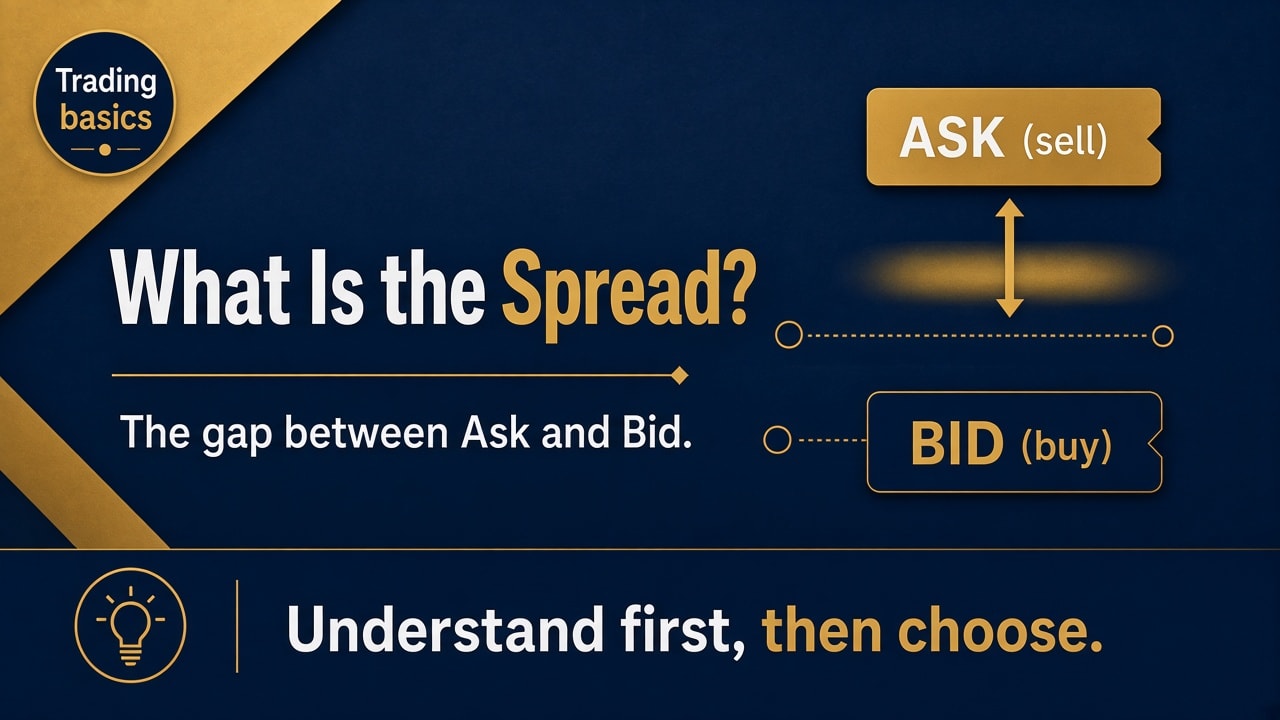
The spread is the difference between the Ask (buy) price and the Bid (sell) price at the same moment. A market buy usually fills at the Ask; if the account marks you to the Bid right away, you often see a small floating loss first. That is usually spread cost — not the only possible explanation for "the platform stole my money," and not proof the market already moved hard against you. Read both sides of the quote before you order; the more often you trade, the more the spread feels like a toll. Platform fee schedules live on each exchange — for example How Binance Trading Fees Work.
Contents
Key definitions
- Ask (buy price)
- The quote you usually pay as a buyer; market buys often fill on this side (terminal rules decide)
- Bid (sell price)
- The quote you usually receive as a seller; closing a long / selling often references this side
- Spread
- Ask − Bid (in quote currency or "pips/points," depending on the instrument)
- Mini example (illustration only)
- If Bid=100 and Ask=100.2, spread=0.2. A market buy at 100.2 marked at 100 is already "down" 0.2 — price must rise past the spread before mark-to-market breaks even
- Fixed vs floating
- Fixed spreads look steadier by name; floating spreads widen with liquidity — news or quiet hours can stretch them suddenly
What this page does not cover
- No stale claims like "this pair is always X wide" — your live quote wins.
- Spread is only one cost; commission, overnight financing, and slippage also matter.
- This page does not rank which broker has the tightest spread.
FAQ
Why am I down the second I buy — is it a scam?
First check whether the gap is about equal to the then-current spread. If it is much larger, look for slippage, delay, or the wrong instrument. Do not conclude "scam" from a screenshot alone — but fake platforms need a different check: How to Check If a Broker or Exchange Is Legit.
Is the spread the same as commission?
No. The spread sits inside the bid/ask; commission is often an extra per trade or per volume. Some accounts are "tight spread, high commission" — add them together.
How do I reduce spread impact?
Cut pointless round-trips; avoid dead liquidity windows; if you use limits, accept that they may not fill. There is no zero-cost trade.