Getting startedComparison
Trading vs Investing: What's the Difference?
Answer
Trading and investing both take part in financial markets and may use stocks, currencies, indices, commodities, or funds — but the emphasis differs. Trading usually focuses on shorter price moves and more frequent entries and exits. Investing usually leans toward holding an asset (or a basket) for longer and tracking its longer-term value. There is no fixed "correct" holding period, and one person can do both. Separating the two helps you read products, fees, account terms, and risk disclosures more accurately — it does not prove either side is a sure win. For single-trade risk, see How to calculate position size.
Contents
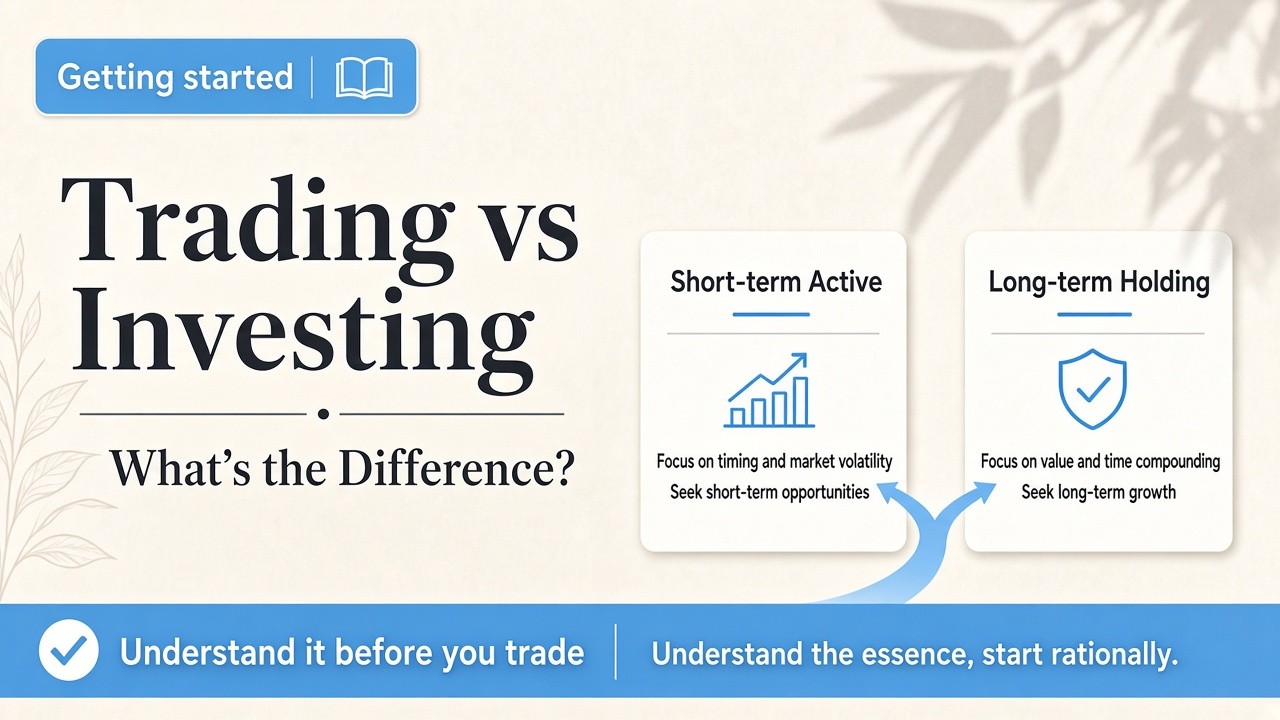
Trading vs Investing
If you need to track short-cycle prices and actively manage entries and exits, you are closer to trading. If the plan is longer holding and the asset's own value, you are closer to investing. Both carry risk; holding longer does not guarantee a positive return.
| Dimension | Trading | Investing |
|---|---|---|
| Typical time horizon | Relatively short: minutes, hours, days to a few weeks are common — varies by person and product | Relatively long: months to years are more common — also varies by person and product |
| Market activity | May require frequent charts, orders, and position management | Usually lower trade frequency; more periodic reviews of holdings and valuation |
| What you watch | Short-term price moves, events, and tape conditions | Longer-term holding value, fundamentals, or the asset itself |
| Common product forms | FX, stocks, indices, commodities, derivatives (futures/CFD-style), depending on platform and country | Stocks, bonds, funds, and other assets people hold for longer |
| Ownership | Depends on the product: some give price exposure without owning the underlying | Often involves the asset or a share of equity (e.g. stock ownership) — still product-specific |
| Platforms and tools | More often a trading terminal, order types, and live quotes | More often account holdings, dollar-cost averaging, or periodic rebalancing |
| Cost structure (typical) | Spread, commission, overnight financing, slippage — more sensitive to frequency and holding time | May include management fees, trading fees, custody or account fees — product-dependent |
| How risk feels | Short-cycle swings and leverage/margin (if used) amplify the path of gains and losses | Asset prices can still move a lot over years; "holding longer" does not erase risk |
Key facts
- Trading (this page)
- Buying and selling financial instruments over a relatively short horizon, with more active entry/exit management; holding can be short or somewhat longer — no single day count
- Investing (this page)
- Usually buying and holding an asset or portfolio for longer, with more focus on the asset's value and a plan than on every intraday tick
- Ownership vs price exposure
- Buying stock may give a share of the company; some derivatives mainly settle price differences and do not equal owning the underlying — the product document decides
- Can you do both?
- Yes. One person can trade short-term and hold other assets long-term. Write separate rules and risk budgets for each sleeve.
- Ask before you act
- How much time can you watch the market? Does the product give ownership or only price exposure? What are the fees? Is margin/leverage involved? Did you read the risk disclosure? How do you verify the provider?
What this page does not cover
- Concept comparison and a decision frame only — no tips on tickers, platforms, leverage, or strategies.
- Table rows are common tendencies, not absolute rules; product docs and local law win.
- No return promises; education is not personalized financial advice.
- Not a full beginner course for one market (FX-only or stocks-only).
FAQ
Is trading always short-term?
Not always. Trading often pairs with shorter holds, but holding can stretch with the product and the person. The key is whether you mainly manage a short-to-medium price path actively.
Does investing always mean you own the asset?
Common stocks often involve ownership, but not every "long-term allocation" product equals direct ownership of one underlying. Read the terms.
Can the same person trade and invest?
Yes. Prefer separate accounts, or at least separate rules: trading sleeves use a clear stop and size formula; investing sleeves use a longer review cycle.
Are CFDs/futures the same as owning stock?
Usually not. Many derivatives give price exposure without the underlying's ownership or shareholder rights, and the cost/risk structure differs.
Why do fees matter so much?
Frequent trading amplifies spread/commission and overnight costs; long holding amplifies management fees and opportunity cost. Fees change the net result — read them before the product pitch.
If I lean toward trading, what next?
Turn a per-trade risk budget into a quantity: How to calculate position size. Then read What is position sizing?.